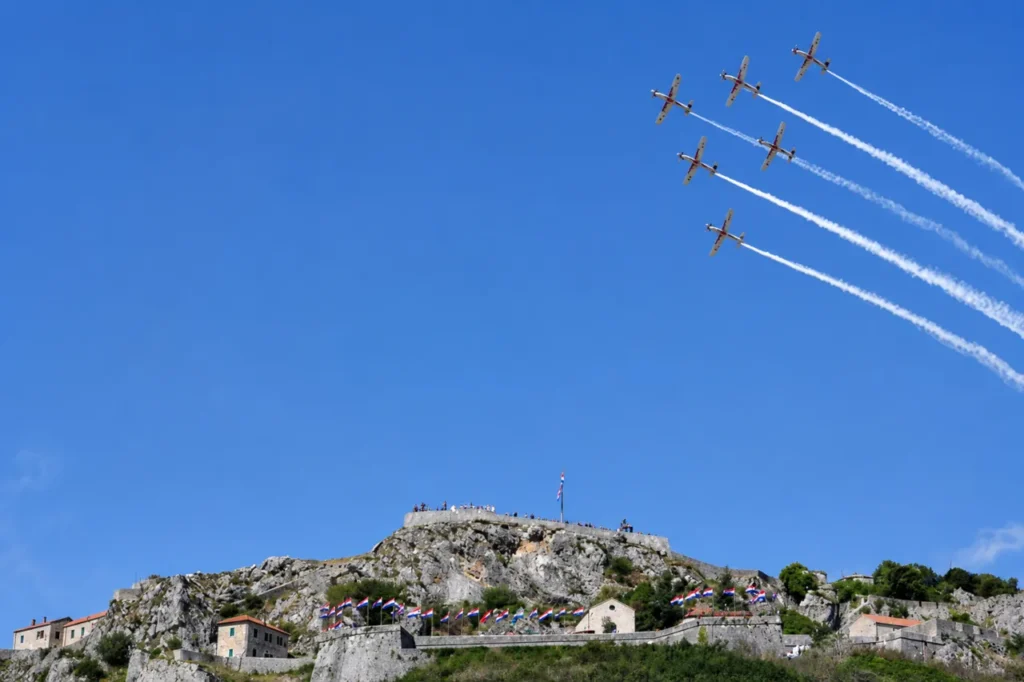
Image: Commemoration of Operation Storm in Croatia/MHB
Operation Storm in Croatia is commemorated every year on 5 August, when the country marks Victory and Homeland Thanksgiving Day and Croatian Veterans Day. The date recalls the liberation of Knin in 1995 and one of the decisive military operations of the Croatian War of Independence.
Thirty-one years ago, Operation Storm in Croatia restored almost all of the country’s occupied territory to its constitutional and legal order, with the exception of Eastern Slavonia, Baranja and Western Syrmia., which were peacefully reintegrated in 1998. Approximately 14% of Croatia’s total territory was liberated during the operation.
Together with Operation Flash (Bljesak), Operation Storm was one of the decisive military operations of the Croatian War of Independence and marked the turning point that led to Croatia’s final victory in its struggle for freedom and independence.
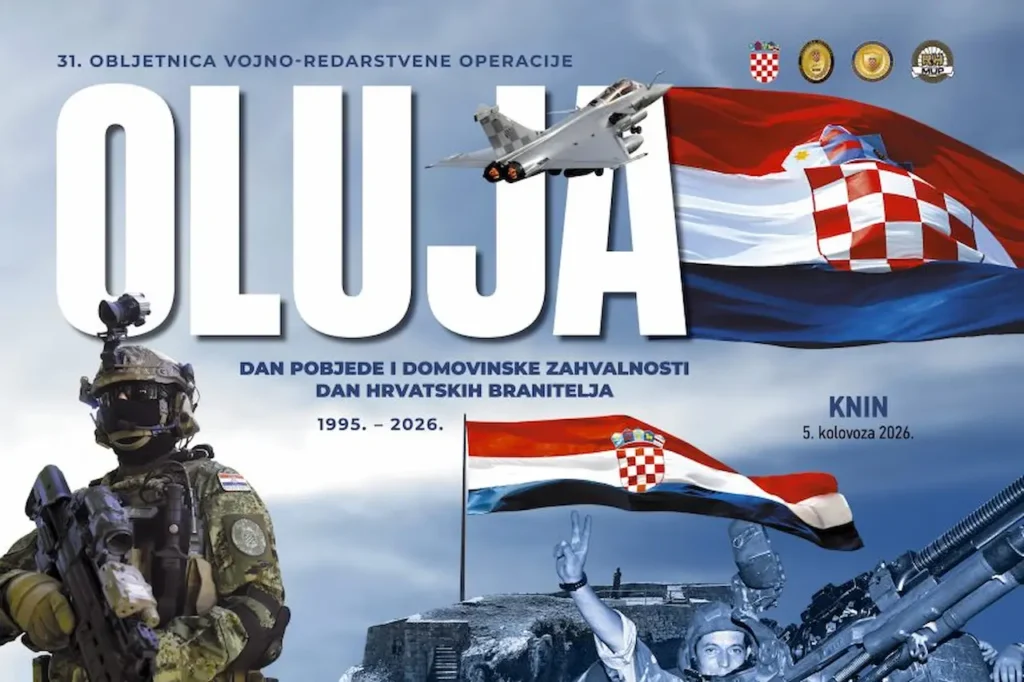
Operation Storm in Croatia began on 4 August 1995
After four years of occupation of almost a quarter of Croatian territory, the displacement of hundreds of thousands of people, constant shelling, and numerous unsuccessful peace initiatives and negotiations, Croatian forces launched Operation Storm on 4 August 1995.
Following initial strikes by the Croatian Air Force, the disruption of enemy communication systems and artillery preparations against military targets, Croatian forces advanced simultaneously from 30 directions along a frontline stretching nearly 600 kilometres.
The main assault force consisted of Croatia’s elite Guards Brigades, supported by Special Police units of the Ministry of the Interior, the Croatian Guards Corps, Home Guard units and reserve forces.
Offensives were launched simultaneously along several key directions, including Bosansko Grahovo–Knin, Josipdol–Plaški–Bihać, Petrinja–Hrvatska Kostajnica, and Karlovac–Slunj.
The advance towards Knin and the relief of Bihać
The conditions for the advance on Knin had already been created during Operation Summer ’95. Croatia’s 4th and 7th Guards Brigades advanced from the Dinara mountain range towards the city, while Special Police units pushed forward from Velebit via Sveti Rok.
The 1st Croatian Guards Corps was deployed deep behind enemy lines in a helicopter assault.
Further north, the 1st Guards Brigade advanced through the areas of Kapela, Slunj, Rakovica, Korenica and Plitvice with the objective of linking up with the 5th Corps of the Army of Bosnia and Herzegovina and breaking the siege of the Bihać enclave.
Meanwhile, the 9th Guards Brigade was tasked with securing the Ljubovo Pass and neutralising the enemy air base at Udbina.
Heavy fighting in the Banovina region
Croatian forces also advanced from several directions in the Banovina region. The 2nd Guards Brigade spearheaded the offensive towards Petrinja, where enemy resistance was particularly strong, before continuing towards Glina.
At the same time, the 3rd and 5th Guards Brigades remained on standby in eastern Croatia in case of possible enemy movements.
On the first day of the operation, Croatian forces advanced between five and fifteen kilometres, surrounding or partially encircling numerous enemy strongholds.
By the second day, around 80% of the planned combat objectives had already been achieved.
The liberation of Knin
During the operation, Croatian forces liberated a number of previously occupied towns, including Hrvatska Kostajnica, Petrinja, Glina, Slunj, Gračac, Obrovac and Drniš.
Knin, which had served as the political and military centre of the Serb rebellion in Croatia, was also liberated. The raising of the Croatian flag over the Knin Fortress symbolised the achievement of the most important strategic, political and military objective of Operation Storm and one of the defining moments of the Croatian War of Independence.
Several days later, on the northern front, the 21st Kordun Corps surrendered.
More than 11,000 square kilometres liberated in 85 hours
Operation Storm lasted 85 hours and involved nearly 200,000 Croatian soldiers and police officers.
A total of 243 Croatian defenders were killed, 1,430 were wounded, and two remain missing.
More than 11,000 square kilometres of previously occupied territory were liberated. The Croatian Armed Forces achieved all of their military objectives and restored Croatian sovereignty over most of the country’s territory.
The operation also laid the foundations for the peaceful reintegration of the remaining occupied areas of eastern Croatia, completed in 1998.
A day of remembrance, gratitude and pride
Operation Storm in Croatia remains one of the most significant events in the country’s modern history. Its success created the conditions for the end of the war, the return of displaced persons, and the restoration of Croatia’s territorial integrity.
Victory and Homeland Thanksgiving Day and Croatian Veterans Day are therefore dedicated to remembering everyone who participated in defending Croatia, especially the Croatian defenders who lost their lives, were wounded or remain missing.
This article on Operation Storm in Croatia is based on official information published by the Croatian Ministry of Defence (MORH).