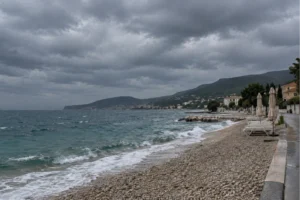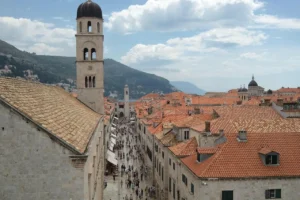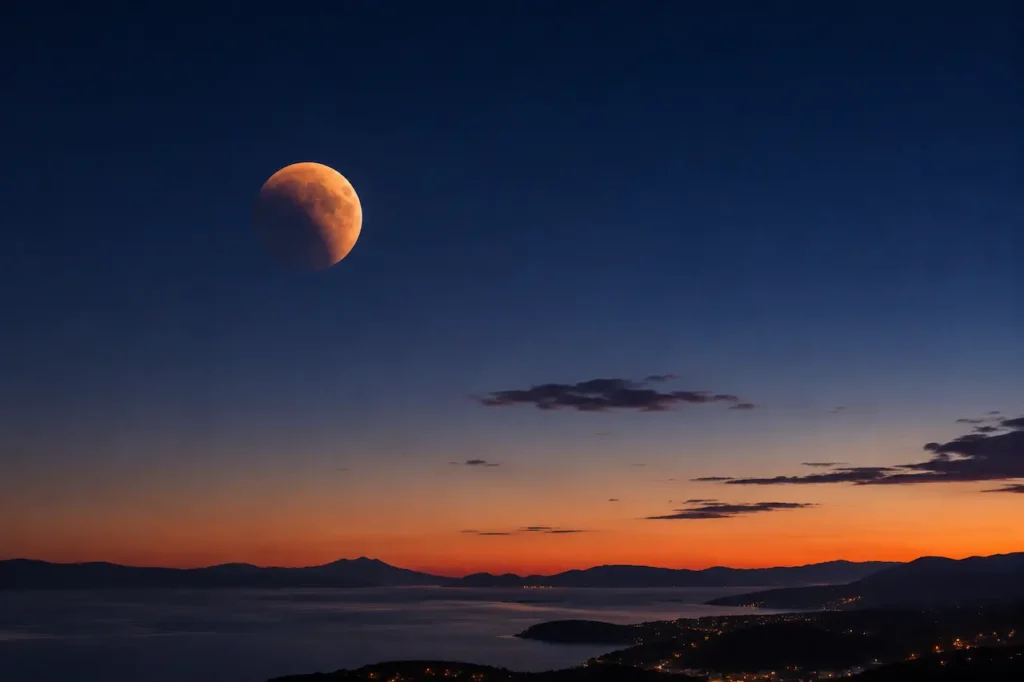
Featured image: Lunar eclipse in Croatia illustration/CU
Early risers will have a chance to see an impressive celestial event on Friday morning, August 28, when a deep partial lunar eclipse in Croatia will be visible across the country.
At the height of the eclipse, around 93% of the Moon’s diameter will be inside Earth’s dark central shadow, known as the umbra, NASA reports. Although the Moon will not be completely covered, much of its surface may appear dramatically darker, with rusty or copper-red colouring.
The lunar eclipse in Croatia will take place in the hours before sunrise, with the later and most dramatic stages occurring while the Moon is already very low in the sky.
When to see the lunar eclipse in Croatia
The eclipse begins at 3:23 am CEST on Friday, August 28, according to Timeanddate.com, when the Moon enters Earth’s lighter outer shadow. The more noticeable partial phase begins at 5:12 am and lasts for about 1 hour and 16 minutes, until 6:28 am.
The deepest locally visible stage will occur shortly after 6 am. Timeanddate calculations show a maximum at around 6:12 am for Zagreb, Split, Zadar, Rijeka and Karlovac. In Dubrovnik, the locally visible maximum is around 6:08 am, while in Osijek it is around 6:03 am.
However, the Moon will be setting during the later stages of the eclipse and may disappear below the horizon before the partial phase officially ends, depending on the location.
Where to watch lunar eclipse in Croatia
The lunar eclipse in Croatia will be visible across the country, but getting a good view of its later stages will depend largely on where you choose to watch it.
By the time the eclipse approaches its locally visible maximum, the Moon will be extremely low in the western sky and close to setting. A location with a clear, unobstructed view towards the western horizon will therefore offer the best chance of seeing the most dramatic part of the event.
Buildings, hills and mountains could block the Moon during the final stages, so an open viewpoint, coastline or other location with a wide view towards the west is preferable.
Observers do not need any special equipment. A lunar eclipse is completely safe to watch with the naked eye, NASA notes, although binoculars or a small telescope can provide a closer view of Earth’s curved shadow moving across the Moon.

Why could the Moon turn red?
A partial lunar eclipse occurs when Earth moves between the Sun and the Moon, placing part of the Moon inside Earth’s shadow.
During Friday’s eclipse, a particularly large portion of the Moon will enter the umbra, the darkest part of that shadow. Royal Museums Greenwich explains that the portion inside the umbra may appear reddish or copper-coloured because sunlight passing through Earth’s atmosphere is scattered and refracted towards the Moon.
This reddish appearance is also why lunar eclipses are sometimes popularly referred to as a “blood moon”. However, Friday’s event is not a total lunar eclipse. Nowhere in the world will the Moon be completely inside Earth’s umbra during this eclipse.
Another eclipse just two weeks later
Friday’s event comes just over two weeks after the partial solar eclipse on August 12, and the timing is not a coincidence.
Royal Museums Greenwich explains that a solar eclipse always occurs around two weeks before or after a lunar eclipse. The two events occur during the same eclipse season, when the alignment of the Sun, Earth and Moon makes eclipses possible.
For Croatia, Friday morning offers another opportunity to watch that alignment in action. Those planning to see the lunar eclipse in Croatia will need an early alarm, a clear sky and, most importantly, an open view of the western horizon.