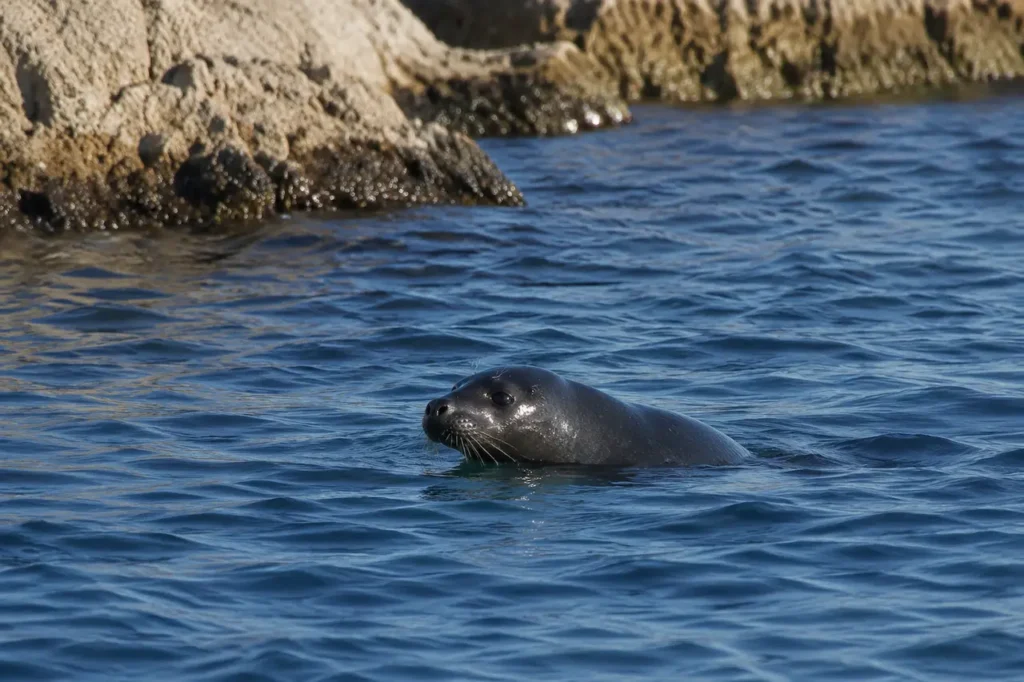
Featured image: Mediterranean monk seal in Croatia illustration/CU
A rare visitor has been moving along the Croatian coast this summer. A Mediterranean monk seal was first photographed near Bibinje in the Zadar area before later being recorded much farther south near Pelješac.
People also reported seeing the animal near Turanj and around the island of Pašman. According to HRT, the clearest photograph was taken near Bibinje on August 4. By August 17, the seal had been spotted near Pelješac and appeared to be moving south towards the Ionian Sea.
The latest sighting of a Mediterranean monk seal in the Adriatic is unusual because the region has not supported an established monk seal population for decades.The animals seen here are thought to be occasional visitors, probably arriving from the nearest colony in the Ionian region.
Why this Mediterranean monk seal sighting is so unusual
The Mediterranean monk seal is one of the world’s rarest seals and the only seal species native to the Mediterranean.
According to the International Union for Conservation of Nature, only around 800 to 1,000 individuals remain worldwide. Most live in a small number of areas around Greece, Türkiye, Cyprus, Madeira and the Atlantic coast of northwestern Africa.
The species was once found across the Mediterranean, including the Adriatic, but hunting, coastal development and repeated human disturbance pushed it out of much of its former range.
Its population is now showing signs of recovery. The species is still considered vulnerable, but its growing numbers may help explain why individual seals are occasionally appearing in places where they have not been regularly seen for decades.
Is there enough food for the seal to return to the Adriatic?
The sighting raises an obvious question: could the Mediterranean monk seal eventually return to the Adriatic more permanently?
Scientists from Croatia’s Institute of Oceanography and Fisheries recently examined whether the eastern Adriatic still offers enough suitable prey.
They studied long-term trends among fish, octopuses and other marine animals that form part of the seal’s diet. Of the 12 prey species they were able to assess, four showed improving trends, six were stable or produced mixed results and two were declining.
According to the Institute, the overall availability of prey is unlikely to prevent the species from returning to the eastern Adriatic. Conditions may be less favourable in some areas, particularly where declining fish stocks overlap with intensive coastal fishing, but food does not appear to be a problem across the region as a whole.
Food alone will not bring the seal back
A reliable food supply is only one of the things the Mediterranean monk seal needs.
The animals also depend on quiet coastal areas, secluded sea caves and places where they can rest and raise their young without being disturbed. Heavy boat traffic, coastal construction and frequent human activity can make an otherwise suitable habitat impossible for them to use.
For now, any seal in the Adriatic is likely to be a rare visitor rather than part of a permanent population. But recent sightings along the Croatian coast and encouraging research into food availability suggest that the return of Mediterranean monk seals may no longer be impossible.