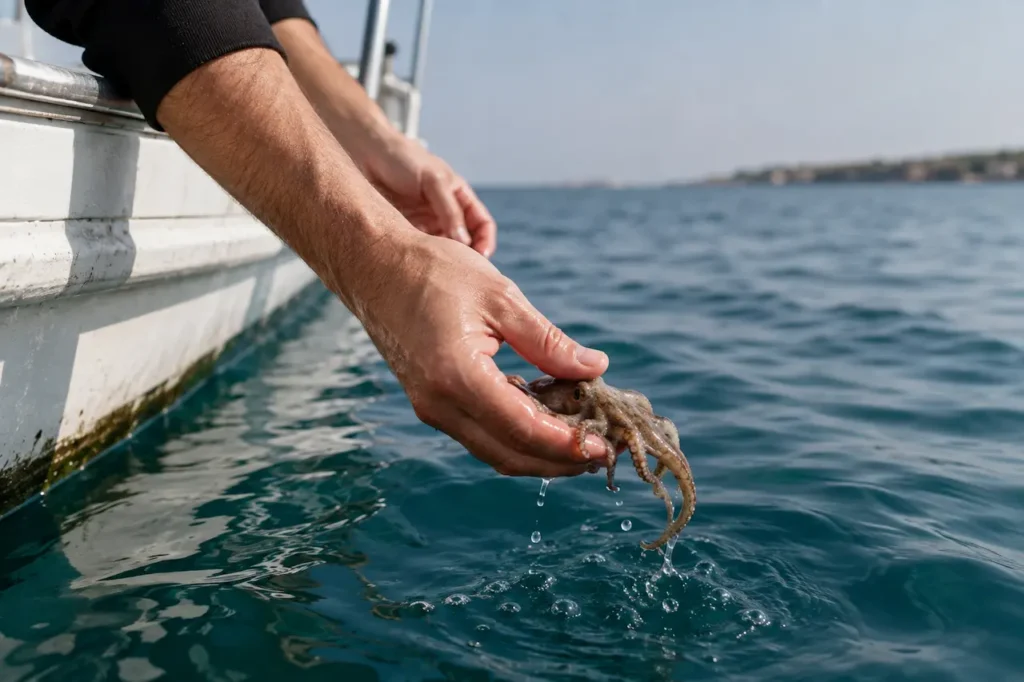
Featured image: Releasing octopuses in the Adriatic Sea illustration/CU
Italian scientists are releasing thousands of young octopuses into the Adriatic Sea as part of an unusual attempt to control the rapidly growing population of invasive blue crabs that has caused severe damage to shellfish production along Italy’s northeastern coast.
According to Phys.org, a team from the University of Bologna hopes that increasing the number of octopuses in the Adriatic Sea waters could provide the invasive crabs with a natural predator and help reduce their impact on fisheries and the marine environment.
The initiative is part of the Octo-Blu project, launched last year with funding from Italy’s Emilia-Romagna region. Researchers have already released around 80,000 young octopuses since June and aim to double that number to approximately 160,000 by the end of August.
The common octopus was chosen for a simple reason: crabs are naturally part of its diet.
“We chose the octopus because, in the wild, it is a formidable predator of crustaceans,” University of Bologna researcher Antonio Casalini told AFP, according to Phys.org.
More octopuses in the Adriatic Sea could help control blue crabs
The young octopuses are bred in white water tanks at a laboratory in the Italian port town of Cesenatico. When they are ready to be released, thousands at a time are transferred into large plastic bags and taken out to sea aboard fishing boats.
Researchers release them near underwater reefs, where artificial dens made from cement and clay have been placed on the seabed to give the young animals suitable places to shelter and improve their chances of survival.
“The idea is to establish a small community close to shore so that it can better combat the spread of the blue crab,” Casalini, an aquaculture technician, told AFP.
Researchers hope at least some of the 160,000 hatchlings will survive and grow into adult octopuses. If successful, establishing more octopuses in the Adriatic Sea coastal areas could eventually help limit blue crab numbers, although the scientists acknowledge that the experiment has important limitations.
The common octopus does not generally favour the warm, sandy lagoon waters where blue crabs are causing the greatest damage. Its impact in those areas could therefore be minimal.
Other potential predators are also being considered. Some experts have suggested that sea bass could be more effective against blue crabs, while the University of Bologna team is investigating the use of eels, which readily eat crustacean eggs, alongside the octopus project.
Blue crabs have caused millions of euros in damage
Blue crabs are native to the Atlantic coast of North America and are believed to have reached the Mediterranean decades ago, most likely in ballast water carried by ships.
Their numbers have increased dramatically in recent years. The Italian government and fishing organisations have linked their rapid expansion to warming waters and climate change.
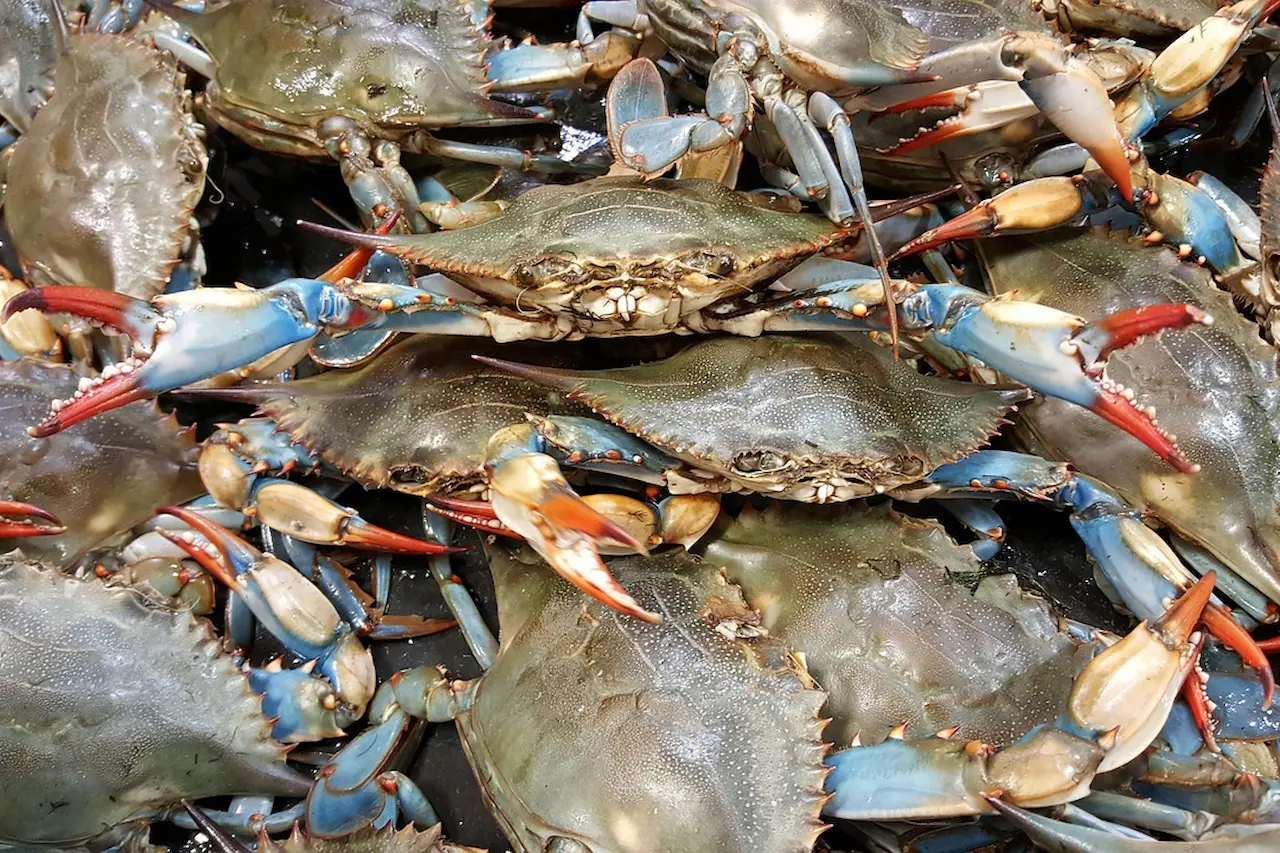
The crabs are excellent swimmers, can weigh up to one kilogram and have powerful blue-tinted claws capable of opening shells. This has made them particularly destructive in northeastern Italy, one of Europe’s major clam-producing regions.
Authorities in Emilia-Romagna said last year that blue crabs had caused almost €17 million in damage in the region since 2022. Italian farming and fishing organisation Coldiretti has estimated the damage across Italy at around €200 million, with the neighbouring Veneto region also badly affected.
“It eats everything, including young clams lying on the seabed,” fisherman and mussel farmer Davide Sanulli told AFP.
Sanulli, who is helping the University of Bologna with the project, described the impact in lagoon areas around the Po River delta even more starkly, telling AFP that the crab “has caused a massacre”.
A predator with enormous reproductive potential
One of the greatest challenges is the blue crab’s ability to reproduce.
“Blue crabs have an incredible reproductive potential and fertility rate,” University of Bologna researcher Pietro Emmanuele told AFP.
A single female can lay millions of eggs. Although only a proportion of the hatchlings survive to adulthood, researchers believe predators could still make a difference if they remove reproductive females from the population.
Even one octopus catching one female blue crab could therefore have an impact, Emmanuele explained.
Blue crabs currently have relatively few natural predators in the affected areas, which is precisely what the Octo-Blu researchers hope to change.
The project is still experimental, and scientists are not suggesting that releasing young octopuses alone will solve the blue crab problem. However, if the pilot proves successful and can be replicated, researchers believe increasing the presence of octopuses in the Adriatic Sea coastal ecosystems could become one tool for limiting the invasive species and reducing the damage it causes to fisheries and marine habitats.
For now, tens of thousands of tiny octopuses are being given their chance, with the researchers hoping some will grow into exactly the kind of crab hunters the Adriatic currently needs.