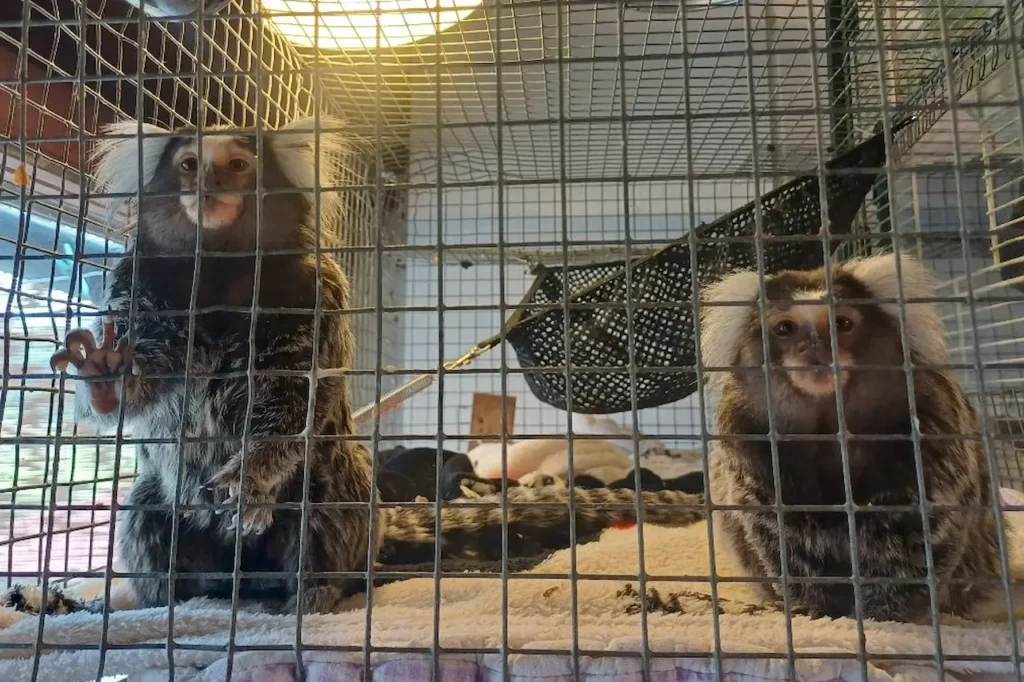
Featured image: Monkeys from Croatia Mini and Rio/Prijatelji životinja
Two marmosets named Mini and Rio have been transferred from Croatia to a specialised sanctuary in Spain after spending almost six years in captivity.
The animals are now at Primadomus, a sanctuary run by Animal Advocacy and Protection (AAP), where they are undergoing mandatory quarantine. Croatian animal protection organisation Animal Friends Croatia, which was involved in arranging their transfer, was present when they left the country.
While Mini and Rio have now reached a suitable home, Animal Friends Croatia says their case highlights a much wider problem: the trade and private keeping of exotic wild animals in Croatia.
Monkeys from Croatia originally came from a Slovenian breeder
Mini and Rio originally arrived in Croatia from a breeder in Slovenia. According to Animal Friends Croatia, they were kept as pets with the intention of later being resold through classified advertisements.
An earlier attempt to transfer them to a sanctuary failed because of complications involving CITES documentation.
The marmosets were eventually taken in by Vedran Lončarić, who wanted to rescue them and find more appropriate accommodation. Since there is no sanctuary in Croatia equipped to house this species, Lončarić worked with Animal Friends Croatia to arrange their transfer to Spain. AAP covered the costs of moving the animals to Primadomus.
Lončarić described just how difficult such animals can be to keep in a domestic environment.
“They attack, and although they are tiny, they can cause serious injuries. It is difficult even to imagine their speed and intelligence,” Lončarić said.
Online ads can hide the reality of keeping wild animals
Animal Friends Croatia warns that classified advertisements can give potential buyers a misleading impression of what keeping animals such as marmosets actually involves.
“Marmosets are promoted as affectionate pets suitable for children. But these animals suffer deeply in domestic conditions because their specific needs regarding diet, temperature and space are impossible to meet,” Animal Friends Croatia said.
The organisation added that when owners can no longer control such animals, they may release them into the wild or turn to zoos for help, even though zoos are not the animals’ natural habitat either.
Animal Friends Croatia says the successful relocation of the two monkeys from Croatia should therefore not obscure the circumstances that allowed them to end up in private captivity in the first place.
“Although at first glance this may seem like a story with a happy ending, this international transfer actually exposes the lack of legal regulation and the growth of a dangerous black market for exotic animals in Croatia,” the organisation said.
It added that monkeys continue to be advertised for sale despite being wild animals unsuitable for life as household pets.
“Instead of addressing the problem only after an animal has been acquired, we need to prevent such situations from occurring in the first place,” Animal Friends Croatia said.
Animal group calls for restrictions on exotic pets
The organisation says poisonous snakes, wild cats, monkeys and other wild animals should not be treated as commodities or household pets.
“We urge people not to buy exotic animals and not to support the cruel trade in living beings that may end up in unsuitable conditions or be abandoned when keeping them becomes too demanding,” Animal Friends Croatia said.
The group instead encourages people who are able to care for an animal to consider adopting an abandoned dog or cat.
Calls for a Positive List in Croatia
Animal Friends Croatia is again calling for Croatia to introduce a so-called Positive List, which would specify the animal species considered suitable to be kept as pets following expert assessment.
The organisation argues that such a system would address the issue before unsuitable wild animals enter private ownership and could significantly reduce the illegal exotic animal trade. It points to Italy, where keeping wild animals is prohibited, and says eight EU member states already use the Positive List model.
The group is calling on Croatian authorities to introduce such a list into national legislation and is also supporting a petition for a Positive List at EU level.
For Mini and Rio, however, the immediate outcome is a new beginning. After almost six years in captivity, the monkeys from Croatia are now in a specialised sanctuary where their needs can be properly addressed.