Most rules in Croatia that tourists should know are generally straightforward and based on the same expectations found elsewhere: respect local residents, do not behave recklessly or endanger others, do not leave rubbish behind and follow clearly displayed signs.
Visitors who follow these basic standards of behaviour are unlikely to have any problems during their stay.
Most things that are illegal in Croatia or prohibited under local regulations are similar to rules in other countries. However, some restrictions have been introduced specifically in response to problems faced by tourist destinations and can still surprise visitors.
Here are seven rules in Croatia that tourists could easily overlook.
Drinking alcohol in public can lead to fines of up to €1,000
Croatia does not have a single nationwide ban on drinking alcohol in all public places. However, public drunkenness is an offence under Croatian law and can result in a fine ranging from several hundred to €1,000.
In addition to this national rule, some Croatian cities have introduced their own restrictions on alcohol consumption in specific public areas, including squares, parks, children’s playgrounds, beaches and historic centres. If you buy several drinks in the evening and sit on public steps in an area where a local ban applies, a municipal enforcement officer may warn or fine you, and the penalties are not small.
Cities may also impose separate restrictions on the sale of alcohol. Makarska, for example, restricted the sale of alcoholic drinks during the evening hours in 2026, which you can read more about here. Split has also initiated the introduction of a similar restriction, but it has not yet entered into force.
Disturbing public order and peace can cost you dearly
Croatian cities, particularly those on the coast, have for years faced problems caused by late-night drinking among some young tourists, damage to historic centres and the disturbance of residents living in city centres.
Police and other competent authorities regularly penalise such offences, with fines amounting to hundreds of euros. If you shout, argue, damage property or otherwise disturb public order while under the influence of alcohol, this may constitute a separate offence and lead to an additional fine that can exceed €1,000, as well as more serious penalties.
The police can also intervene in private accommodation. If you play loud music, shout or otherwise disturb neighbours at night and continue after being warned, police officers may knock on your door.
Do not walk through town in swimwear or underwear
Swimwear is perfectly normal on the beach, by a swimming pool or on a promenade immediately beside a bathing area. However, it is not considered appropriate in most historic centres along the Croatian coast, or in shops, museums and similar places.
Dubrovnik, Split, Hvar, Zadar and other popular tourist cities regulate clothing in public areas through municipal rules. In many cities, walking through historic centres in swimwear, underwear or without clothing is prohibited, and in some places the rule also applies to other parts of the city.
Fines range from €130 to €600, and municipal enforcement officers do actively enforce these rules.
Appropriate clothing rules in Croatia also apply in public institutions, including schools, hospitals and municipal offices.
Sleeping in public places and wild camping are not permitted
Sleeping on a bench, in a square, park, on a beach or another public surface is prohibited by local regulations in most Croatian cities. The prescribed fines often start at €150.
Croatian law prohibits wild camping outside registered campsites and designated camping areas throughout the country, whether you are travelling with a tent, van or campervan. Staying in unauthorised locations can result in fines ranging from €190 to €1,320.
Fire safety rules in Croatia are strictly enforced
Barbecuing in a forest or by the sea may sound like a harmless part of a holiday, but during the wildfire season, an open flame represents a serious offence and a safety risk.
The wildfire season in Croatia runs from 1 June to 30 September, during which lighting fires or combustible materials outdoors is prohibited by law. The authorities particularly warn against barbecuing, discarding cigarette butts and using tools or machinery that create sparks.
Breaking these rules alone can result in a fine, while the consequences are considerably more serious if a spark causes a fire. Fines range from €1,990 to €19,900. A prison sentence of up to 60 days may also be imposed.
Find a toilet
Some people may not consider urinating in public a serious offence. However, as in many other countries, urinating on streets, walls, entrances, in parks or on other public surfaces is punishable under Croatia’s Act on Misdemeanours against Public Order and Peace.
If you choose a quiet side street after leaving a nightclub or bar, you may encounter a municipal enforcement officer, police officer or resident who reports you, and the fines can amount to several hundred euros.
Be careful with rented scooters and motorcycles
Renting an electric scooter, motorcycle or moped does not mean it can be used without restrictions.
In Croatia, electric scooter riders must be at least 14 years old, wear a helmet and follow rules on speed, permitted surfaces and road crossings.
Police regularly check scooter riders and fines range from several dozen to several hundred euros. High-powered scooters that exceed legal limits may even be confiscated.
Standard rules in Croatia on helmets, alcohol, mobile phone use, driving licence categories and parking also apply to motorcycles and mopeds.
What happens if you are caught breaking these rules in Croatia?
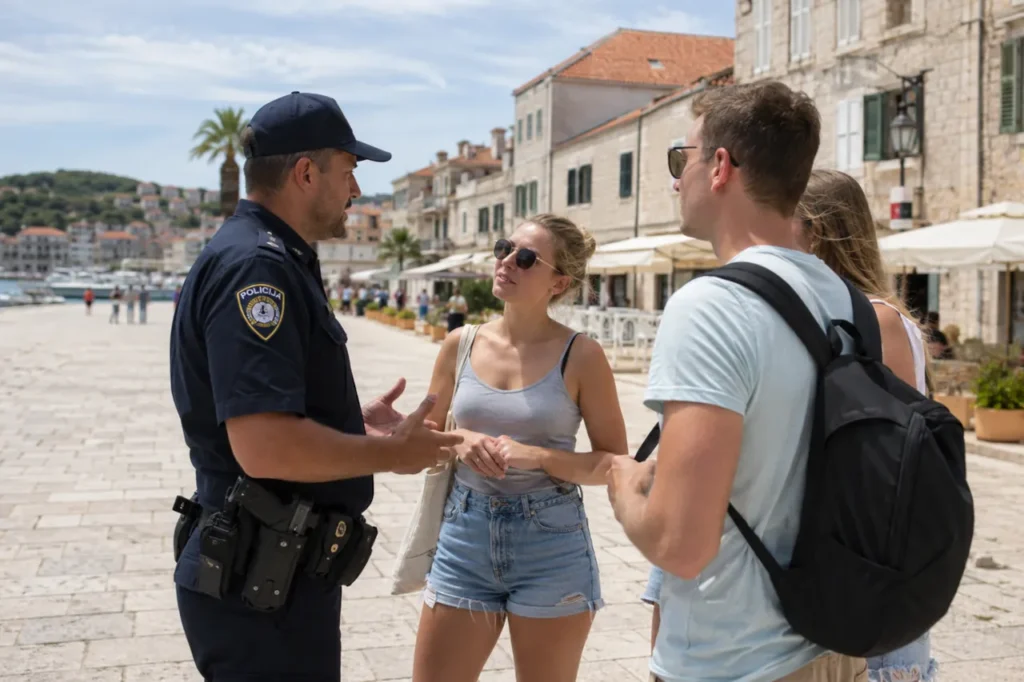
If you are caught committing one of these offences, a police officer, municipal enforcement officer or another authorised official may ask for your identification and issue a warning, fine or penalty notice. You are required to provide an identity document; otherwise, you may be taken to a police station to establish your identity.
Depending on the offence, the fine may be payable immediately and is often lower if paid on the spot, or it may need to be paid within a specified deadline.
Some cases may involve further proceedings. More serious offences, such as causing a fire, damaging property or repeatedly disturbing public order, can lead to much higher penalties or being brought before a judge.
Can a fine reach you after you return home?
For the offences described in this article, tourists are most often fined immediately at the scene. A municipal enforcement officer, police officer or another authorised official identifies the offender and issues a notice, confirmation or penalty order.
If you have already received such a document, leaving Croatia does not cancel the fine. The procedure may continue, and additional notices and payment requests may be sent to your address abroad.
In certain cases, final financial penalties may also be enforced in another European Union member state.
How to avoid an unexpected fine
Avoiding most problems does not require studying dozens of laws. Most rules in Croatia are based on common sense: pay attention to local signs, cover up before entering a historic centre, do not plan to sleep on a beach and do not light a fire without clear confirmation that it is permitted.
When using electric scooters, motorcycles or cars, do not assume that traffic rules are not enforced simply because you are in a tourist destination. When renting a vehicle or other equipment, ask where you are allowed to use it and where it may be left.
Croatia is not a country where tourists are routinely fined for harmless mistakes. However, you will not be exempt from a fine simply because you are a visitor. Paying a little attention to local rules can prevent an ordinary evening, excursion or day at the beach from turning into an unexpected expense.