Featured image: Zadar at night/CU
Zadar has reached the final stage of the European Capital of Tourism 2027 competition, placing the Croatian coastal city among eight smaller destinations selected from across Europe.
The European Commission shortlisted Zadar in the category for cities with between 25,000 and 100,000 residents. The European Capital of Tourism award recognises destinations that are leading the transition towards more sustainable tourism.
Zadar will compete against Calais in France, Calvià and Ibiza in Spain, Geestland in Germany, Nova Gorica in Slovenia, Sandanski in Bulgaria and Selçuk in Türkiye.
Zadar selected from 40 applicants
A total of 40 cities from 17 countries applied in Zadar’s category. Following an assessment by independent experts, eight were selected to present their proposals to a European jury.
The shortlisted cities were evaluated on their approach to sustainability, accessibility, digitalisation, cultural heritage, creativity and support for local talent.
Representatives of the finalists will present their candidatures in Brussels on November 18 and 19. The jury will then select the winner of the European Capital of Tourism 2027 title.
A separate category for cities with more than 100,000 residents includes Aalborg, Braga, Genoa, Konya, Ljubljana, Lviv, Salzburg and Sofia.
Why Zadar reached the shortlist
The European Commission highlighted Zadar’s efforts to protect its cultural heritage and marine environment while making public spaces more accessible to residents and visitors.
One of the projects included in the city’s profile is Zadar Baštini, which transformed former traffic corridors and parking areas beside the historic city walls into greener, pedestrian-friendly public spaces.
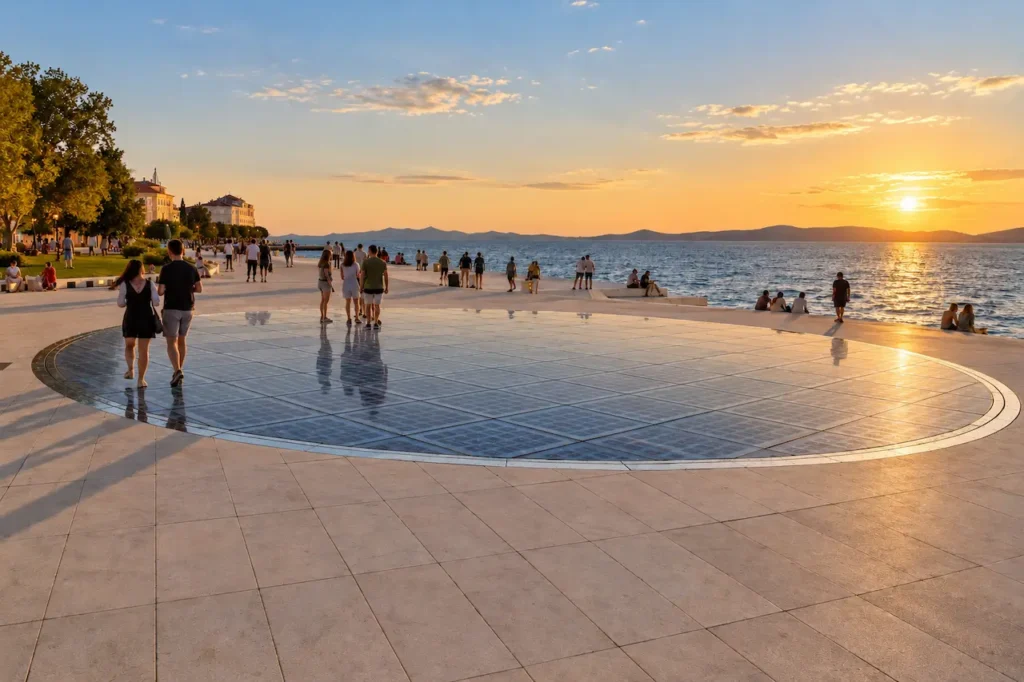
The city’s two best-known modern attractions also feature prominently. The Sea Organ uses the movement of the waves to produce sound through pipes beneath the waterfront, while the nearby Greeting to the Sun collects solar energy during the day and uses it to power its evening light display.
Both attractions connect technology with the natural environment and have become defining parts of Zadar’s waterfront.
Technology used to monitor the sea
Zadar’s candidature also includes a marine monitoring system at the cruise port.
The system uses artificial intelligence and satellite data to monitor seawater quality and possible signs of pollution in real time. Information is available to residents and visitors through an application, providing greater transparency about the environmental effects of cruise traffic.
Upgrades to the water supply and wastewater treatment systems were also cited as measures intended to reduce pollution risks and conserve water.
The city has additionally adopted a Green Urban Renewal Strategy covering the period from 2025 to 2034. It includes plans for new green areas, improved green and blue infrastructure and projects intended to help the city cope with increasingly intense summer heat.
Another Croatian Destination Could Become European Capital of Tourism
Zadar’s place on the shortlist follows Dubrovnik’s selection as the European Green Pioneer of Smart Tourism for 2026.
The European Commission has since brought its former smart tourism and green pioneer competitions together under the unified European Capital of Tourism name. Two cities will receive the 2027 title, one from each population category.
If Zadar is selected, Croatia would receive European recognition for sustainable tourism for a second consecutive year.
The winner will receive promotional and branding support from the European Union, including a destination video, international promotion and a sculpture to be installed in the city.
More information about Zadar’s candidature is available on the official European Capital of Tourism website.