Featured image: Hidden portrait in Dubrovnik/Dubrovački muzeji
A portrait displayed inside Dubrovnik’s Rector’s Palace had concealed another woman’s face beneath its painted surface for generations.
Research into the Portrait of Marija Ghetaldi-Gondola, painted by Carmelo Reggio around 1812, revealed an earlier female portrait hidden underneath the image visible today. A partially preserved inscription allowed researchers to identify the woman as Frana Gondola, née Bona.
The discovery was made during conservation and restoration work carried out by Dubrovnik Museums and the Croatian Conservation Institute. The research has now been presented to international conservation experts at a congress in Ghent, Belgium.
An eye beneath the visible portrait
The painting forms part of the permanent collection of the Cultural History Museum and is normally displayed in the Music Room of the Rector’s Palace.
After a crack was noticed on its surface, the valuable painting was sent to the Dubrovnik Conservation Department of the Croatian Conservation Institute in 2023.
During the examination, experts noticed an unusual detail: the dark outline of an eye was visible around the neck of Marija Ghetaldi-Gondola in the finished portrait.
A series of non-invasive analytical methods subsequently confirmed that another painting existed beneath the visible layer.
The earlier work was not simply an abandoned sketch. It was a separate portrait of a woman accompanied by an inscription identifying her as Frana Gondola, born into the Bona family.
Two women and one Dubrovnik family
The hidden portrait in Dubrovnik opened a new chapter in the history of the painting and the noble families connected with it.
Researchers were able to compare the concealed image with other portraits in the Dubrovnik Museums Painting Collection and connect it with works by Austrian painter Franz Xaver Span.
Archival and historical research also revealed previously lesser-known details about the Ghetaldi and Gondola families, turning the conservation project into a broader investigation of Dubrovnik’s social and family history.
The results were presented to the public through the exhibition A Look Through the Portrait of Marija Ghetaldi-Gondola, which opened at the Rector’s Palace in November 2024.
Rather than removing the visible portrait to expose the earlier painting, the exhibition used the findings of the scientific examination to tell the story of the two women whose images occupy the same canvas.
Dubrovnik research selected from 380 submissions
The research has now received recognition from the international conservation community.
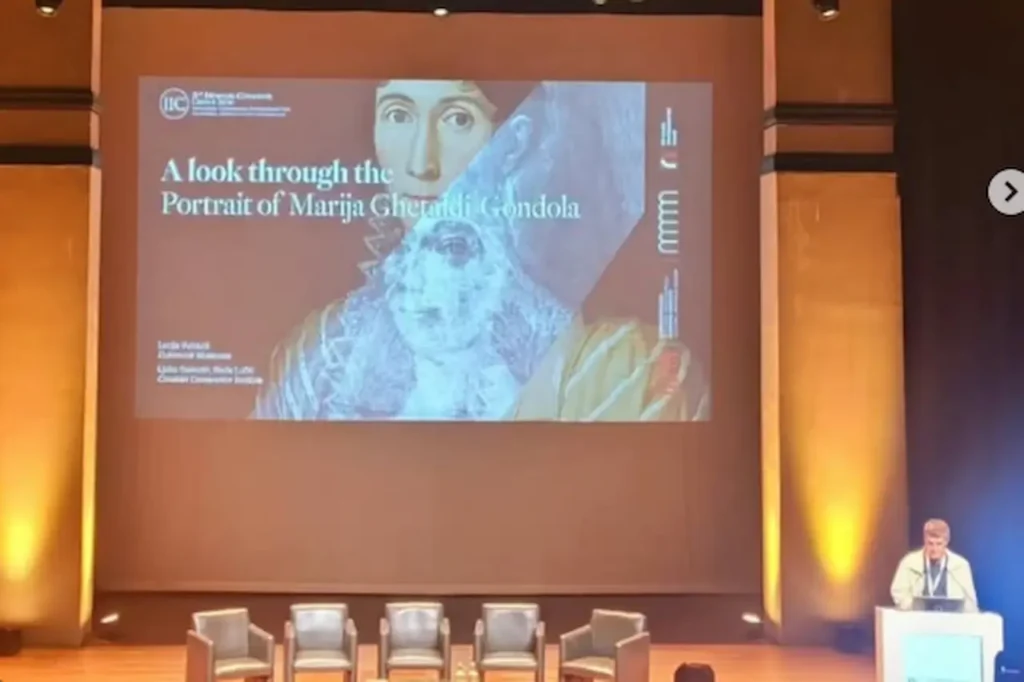
Lucija Vuković, senior curator at the Cultural History Museum of Dubrovnik Museums, co-authored the paper A Look Through the Portrait of Marija Ghetaldi-Gondola with Croatian Conservation Institute experts Nađa Lučić and Ljubo Gamulin.
Their work was selected for presentation from approximately 380 submissions received for the congress of the International Institute for Conservation of Historic and Artistic Works.
The congress was held in Ghent from September 8 to 11, with Gamulin presenting the Dubrovnik research to the international professional community.
Findings published in an international journal
The study of the hidden portrait in Dubrovnik has also been published as a scientific article in Volume 71 of the international journal Studies in Conservation.
The project brought together museum curators, conservators, restorers and researchers from Dubrovnik Museums and the Croatian Conservation Institute.
Their work demonstrates how the conservation of a familiar museum object can uncover an entirely different artwork and restore the identity of someone whose portrait had disappeared from view.
The visible painting remains part of the permanent collection at the Cultural History Museum in Dubrovnik’s Rector’s Palace.
More information about the conservation project that revealed the hidden portrait in Dubrovnik and the earlier exhibition is available from Dubrovnik Museums