This article contains affiliate links. If you book through them, we may earn a commission at no extra cost to you.
Renting a car in Croatia can make travelling around the country considerably easier, particularly if you want to explore smaller coastal towns, national parks, rural areas or several destinations during the same trip.
But booking the cheapest car you find is not always the cheapest option in the end. Deposits, insurance excess, card requirements, cross-border travel and additional fees can all become unpleasant surprises if you only discover them when you arrive at the rental desk.
If you are planning to rent a car in Croatia, there are a few things worth checking before you book.
Compare rental car prices and conditions from different companies in Croatia through Discover Cars.
Do you actually need a rental car in Croatia?
It depends heavily on your itinerary.
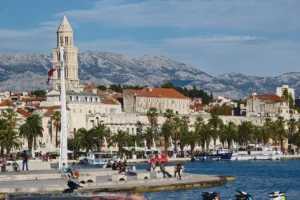
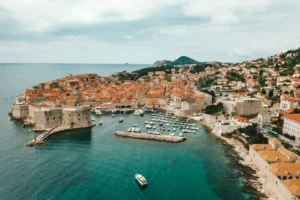
If you are spending several days exclusively in Split, Dubrovnik or Zagreb, a rental car may be more trouble than it is worth. City centres are walkable, public transport is available and parking can be both difficult and expensive, particularly in Split and Dubrovnik during summer.
A car becomes much more useful if you are travelling between several destinations or want to explore places that are difficult to reach conveniently by public transport.
The same applies if you are staying in a village or more isolated accommodation away from the main tourist centres.
What documents do you need to rent a car in Croatia?
To rent a car in Croatia, you will need at least a valid driving licence and identification, usually a passport or national ID card.
Croatian authorities allow foreign visitors to drive using a valid foreign driving licence, subject to the applicable recognition rules. Croatia’s Ministry of the Interior states that visitors who can drive on the basis of a recognised valid foreign licence do not additionally need an International Driving Permit.
However, the legal right to drive in Croatia and the requirements imposed by a rental company are two different things.
Rental companies can have their own conditions regarding the driver’s minimum age, how long you must have held your licence and which documents they require when collecting the vehicle.
Always check these conditions for the company and vehicle you are booking rather than assuming that all Croatian rental companies follow identical rules.
Don’t overlook the security deposit
The advertised rental price is not necessarily the amount of money you need available when collecting the vehicle.
Rental companies commonly place a security deposit or pre-authorisation on a payment card. The amount depends on the company, vehicle category and insurance package you have selected.
This money is generally not taken as a normal payment, but the corresponding amount of your credit limit or account balance may remain unavailable until the hold is released.
For that reason, don’t just compare daily rental prices. Check the required deposit before booking as well. A slightly more expensive rental with a manageable deposit may be a much better choice than the cheapest offer with conditions that don’t work for you.
Find the best rental car for your trip to Croatia below.
Do you need a credit card to rent a car in Croatia?
This is one of the most important things to check before paying for a rental car.
To rent a car in Croatia, most companies require a credit card in the main driver’s name for the security deposit.
In other words, even if a rental company allows you to pay for the rental by debit card or cash, you may still need a credit card when collecting the car.
Finding this out only when you arrive at the rental desk can be frustrating and is not exactly the best way to start a holiday.
Rental car insurance can be confusing
Rental car insurance can be confusing, so focus first on the excess – the amount you may still have to pay if the car is damaged.
Also check who provides any additional coverage. Insurance bought through a booking platform may work as reimbursement, meaning the rental company can charge you first and you then claim the money back separately.
Do not rely only on labels such as “full coverage”. Check whether tyres, wheels, glass, the underside of the car, lost keys and incorrect refuelling are included.
Photograph the car before leaving
This takes five minutes and can save considerable trouble later.
Before driving away, walk around the vehicle and photograph or film its condition. Pay particular attention to existing scratches and dents, bumpers, wheels and rims, windscreen and mirrors.
Make sure any existing damage is recorded on the rental documentation. It is also useful to photograph the dashboard showing the mileage and fuel level.
Do the same when returning the vehicle, particularly if you are leaving it outside office hours.
Can you take a rental car on a ferry in Croatia?
If your Croatian itinerary includes an island, don’t automatically assume your rental agreement allows everything you have planned.
Cars can be transported on Croatian car ferries and taking a vehicle to islands such as Brač, Hvar or Korčula is common. However, your rental agreement may contain specific conditions regarding ferry travel. Check the rental company’s policy before booking, particularly if your trip involves several islands.
Remember that not every boat connection carries vehicles either. Croatia has both car ferries and passenger-only catamarans, so check the specific route when planning your journey.
Read more in Croatian Ferry System Explained: Cars, Catamarans, Tickets and Boarding
Can you take a Croatian rental car across the border?
Travellers often combine Croatia with neighbouring Bosnia and Herzegovina, Montenegro or Slovenia. Many rental companies allow cross-border travel, but their conditions vary, so this is something to arrange before you collect the car.
For trips outside the EU, ask the rental company specifically about cross-border insurance and the Green Card, an international certificate confirming that the vehicle has valid third-party motor insurance. Depending on the rental company and destination, the Green Card or other cross-border documentation may need to be issued in advance.
It is best to request it well before collecting the car, as some rental companies may need several days to issue the.
Returning the rental car in another Croatian city
One-way rentals can be extremely useful in Croatia. For example, you could collect a car in Zagreb and return it in Split or Dubrovnik instead of driving all the way back to your starting point.
The downside is that one-way rentals are usually significantly more expensive than returning the car to the same location. Rental companies commonly charge an additional one-way fee, and the difference can be substantial depending on the route and company.
Compare the total price before booking. Depending on your itinerary, the higher cost may still be worth it if it saves you a long return drive or an extra day of travel.

A few rental details worth checking
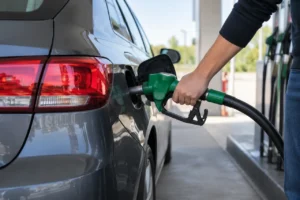
Before leaving the rental desk, check the fuel policy, mileage allowance and whether any additional drivers need to be added to the rental agreement. Full-to-full fuel policies and unlimited mileage are common, but they should not simply be assumed, especially if you are planning a longer road trip across Croatia.
When returning the car, make sure you follow the agreed fuel and return conditions. It is also a good idea to photograph the vehicle, fuel gauge and mileage before handing over the keys, particularly if you are returning the car outside office hours.
Driving a rental car in Croatia
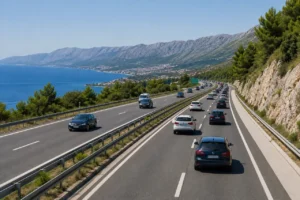
Croatia has an extensive motorway network connecting Zagreb with much of the coast, and the main roads between popular destinations are generally straightforward to navigate.
Most Croatian motorways charge tolls. On motorways, tolls are generally calculated according to the distance travelled and vehicle category. Payment at toll booths can be made in euros or with commonly accepted bank cards, as well as through the ENC electronic toll system.
Observe speed limits and other traffic rules carefully. Traffic offences in Croatia can result in substantial fines, and enforcement is common on major roads and in tourist areas.
Also pay attention to local traffic restrictions in city centres. Dubrovnik, for example, has a restricted traffic zone with special access rules for vehicles. You can read more about this in our guide Dubrovnik Old Town Traffic Restrictions: Where You Can (and Can’t) Drive.
Traffic can become particularly heavy on Saturdays and around major holiday weekends in July and August, when large numbers of visitors are arriving and leaving accommodation at the same time. These periods also bring a higher risk of accidents, so take extra care, avoid rushing and stop for a break if you are tired.
Parking may be harder than driving
For many visitors, driving in Croatia is not the difficult part. Finding somewhere to leave the car is.
This is particularly true in Split and Dubrovnik during summer and around historic centres throughout the Croatian coast.
Accommodation advertised as being “in the centre” does not necessarily include parking and in pedestrianised old towns it may not even be possible to drive directly to your accommodation.
If you are booking an apartment, check exactly what “parking available” means. Private parking at the property is very different from public parking somewhere nearby.
If your itinerary includes several days in a city followed by a road trip, consider collecting your rental car only on the day you leave the city. There is little benefit in paying for both a rental car and parking while the vehicle sits unused for three days.
Choosing the right rental car for Croatia
The best rental car for Croatia depends largely on where you plan to drive.
If your trip is focused on coastal towns and islands, a smaller car is often the most practical choice. Streets in historic centres and older neighbourhoods can be narrow, parking spaces are limited, and summer traffic can make manoeuvring a larger vehicle unnecessarily difficult.
If you plan to spend more time inland, in rural areas or away from the main roads, a slightly higher and more robust car can be useful. You do not necessarily need a 4×4, but some local roads and access routes can be rough or unpaved.
For longer road trips, comfort matters more than it may seem when booking. Croatia is a long country, and driving between destinations can mean several hours on the road. Most importantly in summer, make sure the car has reliable air conditioning. Temperatures can become extremely high, particularly in July and August.
In short: Before you rent a car in Croatia
Before you rent a car in Croatia, take a few minutes to check the conditions that matter most for your trip, including the deposit and card requirements, insurance, mileage, fuel policy and any additional fees.
If you plan to cross a border, take the car on a ferry or return it in another city, confirm those conditions in advance as well.
Once that is sorted, renting a car can make travelling around Croatia much easier and give you far more freedom to explore places beyond the main cities and busiest tourist routes.